
What Does MVHR Stand For?
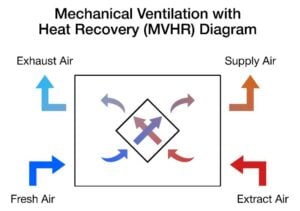
MVHR stands for Mechanical Ventilation with Heat Recovery. “Mechanical” refers to the system’s controlled operation, “Ventilation” involves air circulation, and “Heat Recovery” retains warmth during air exchange.
How Does MVHR Work?
Mechanical Ventilation with Heat Recovery works by circulating fresh outdoor air into a building while simultaneously extracting stale indoor air. It recovers heat from the outgoing air to warm the incoming air, improving energy efficiency and indoor air quality.
Does MVHR Filter The Air?
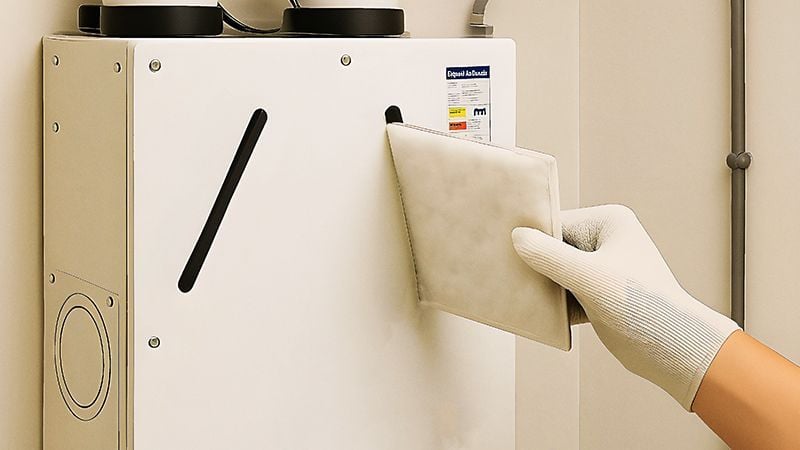
MVHR filters outdoor air before circulation, trapping pollutants. Stale indoor air is also extracted, maintaining a fresh environment. It can eliminate dust, pollen, allergens and pollutants, creating healthier indoor air quality. Mechanical Ventilation with Heat Recovery filters typically come in four grades: G2, G3, G4, and M5.
Does MVHR Work During The Winter?
During winter, Mechanical Ventilation with Heat Recovery systems employ a heat exchanger plate. It transfers warmth from outgoing air to incoming fresh air, ensuring indoor coziness. The heat exchanger redistributes warmth throughout the building, lowering energy costs and enhancing overall efficiency.
Does MVHR Work During The Summer?
In summer, MVHR systems can incorporate a summer bypass feature. This function allows heat to exit directly without passing through the heat exchanger, maintaining indoor comfort. This can be an automatic feature of manual, depending on the machine.
Does MVHR Reduce Damp?
Mechanical Ventilation with Heat Recovery plays a crucial role in reducing dampness within a building. The system continuously exchanges stale indoor air with fresh outdoor air while simultaneously recovering heat from the outgoing air to preheat the incoming air. By doing so, MVHR helps maintain a controlled and balanced indoor humidity level. By expelling excess moisture-laden air, particularly in areas prone to dampness like bathrooms, the system prevents the accumulation of moisture indoors. Furthermore, the heat recovery process ensures that incoming air is pre-warmed, reducing the likelihood of condensation forming on cold surfaces.
In Summary…
Mechanical Ventilation with Heat Recovery improves indoor air quality, energy efficiency, and comfort. It circulates fresh air while extracting stale air, filtering out contaminants. During winter, a heat exchanger plate ensures warmth, while in summer, a bypass feature maintains comfort.