
G3 Grade MVHR filter media is vital to ensuring healthy indoor air across British homes and commercial spaces. This filtration material, designed to cost-efficiently capture airborne contaminants, plays a crucial role in enhancing the effectiveness of MVHR systems. From residential buildings to offices, it ensures the circulation of fresh and purified air.
In this article, we explore G3 filter media: its properties, applications, and the positive impact it has on indoor environments.
What Can G3 Filter?
In air filtration, G3 falls between G2 (lowest) and G4 (medium), while M5 ranks highest for superior filtration efficiency.
It is effective at capturing a range of airborne particles, including:
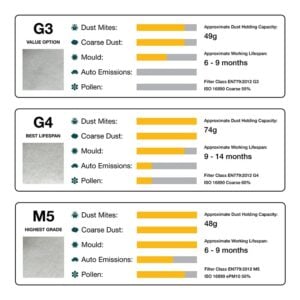
How does G3 Compare to G4?
Both G3 and G4 filters are capable of capturing particles in the 3 to 10 micron range. This includes common contaminants like dust, pollen and larger allergens. However, G4 filters exhibit a higher retention rate, making them more effective at filtering out these particles. The higher retention rate means that G4 filters have a superior ability to trap more particles within this size range. This contributes to improved indoor air quality and making them a preferred choice in environments where enhanced filtration is desired.
In Summary…
In conclusion, G3s ability to capture a wide range of airborne particles plays a vital role in enhancing indoor air quality. From residential homes to commercial spaces, it offers a practical and efficient solution for cleaner and healthier environments. Its versatility, cost-effectiveness, and contribution to overall well-being make it a valuable asset in the pursuit of better air quality.
| ← Lower Grade Material |
Higher Grade Material → |
| Learn About G2 Grade Material |