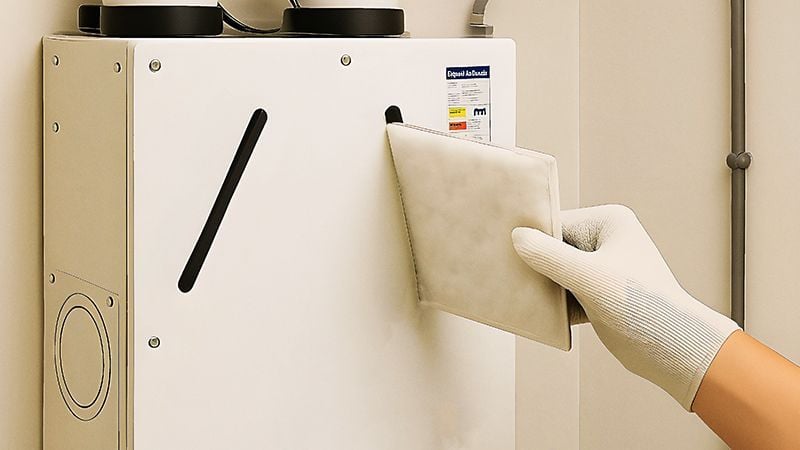

In today’s energy-efficient homes and buildings, Mechanical Ventilation with Heat Recovery (MVHR) emerges as a vital technology. These systems play a crucial role in maintaining indoor air quality while conserving energy. At the heart of every MVHR system lies a fundamental component: MVHR filters.
In this article, we will explore the ins and outs of MVHR filters, looking at: their purpose, grades and maintenance.
What do MVHR Filters do?
The primary role of MVHR filters is to safeguard and enhance indoor air quality. These filters act as the gatekeepers of the ventilation system, serving as the first line of defence against airborne contaminants. As incoming and outgoing air passes through the system, the filters capture particles such as dust, pollen, allergens and pollutants. By entrapping these undesirable elements, the filters prevent them from circulating within the property, thereby ensuring the occupants breath easier.
What Filter Grades do MVHR Filters Come in?
MVHR filters come in a range of grades, each denoted by a specific classification, including: G2, G3, G4, and M5. These grades reflect varying levels of filtration efficiency and particle capture capabilities. G2 filters are often the coarsest and are designed to capture larger particles like dust and debris. Moving up the scale, G3 filters provide slightly better filtration, while G4 filters are even more efficient with a higher dust holding capacity. At the higher end, M5 filters offer exceptional filtration, capable of capturing very fine particles, including fine dust and pollen.
What MVHR Filters Should I Choose?
When selecting the appropriate filter grade, several critical factors should be considered. Firstly, local air quality conditions play a significant role. If the surroundings have elevated levels of outdoor pollutants, opting for a higher-grade filter becomes imperative to combat these contaminants. Secondly, specific indoor air quality goals must be taken into account. The occupants’ health needs may prioritise certain aspects of filtration, such as allergen removal.
Can you Clean MVHR Filters?
MVHR filters can be cleaned gently using a vacuum cleaner to remove surface dust and debris. However, it’s essential to note that this maintenance method has its limitations. Over time, filters can accumulate not only visible particles but also finer contaminants that penetrate deeper into the filter media. As a result, despite periodic cleaning, the filters will gradually lose their efficiency. Therefore, to ensure the continued effectiveness of the ventilation system, it is typically recommended to replace these filters approximately every 6 to 12 months, depending on usage and environmental conditions. This regular replacement interval helps maintain optimal filtration performance, ensuring that the indoor air remains clean and healthy.
In Summary…
In conclusion, MVHR filters play a pivotal role in modern ventilation systems. These components diligently capture contaminants, from coarse particles to allergens, preventing them from circulating within our living and working spaces. Understanding filter grades and maintenance allows us to create healthier indoor environments by ensuring clean, efficient ventilation systems.